Guitar Modes, Simply
Modes sound mysterious and get over-explained. They're really one idea: the major scale, started on a different note. See it and hear it and it clicks.
The one idea behind all modes
Take a C major scale— C D E F G A B. Now don't start on C. Start on D and treat it as home: D E F G A B C. Same seven notes, but centred on D, it sounds minor and a little cool — that's D Dorian. Centre on G and you get G Mixolydian. A mode is just the major scale with a different note as home.
The seven, brightest to darkest
- Lydian — major with a raised 4th; dreamy, floating.
- Ionian — the plain major scale; bright, resolved.
- Mixolydian — major with a ♭7; bluesy, rootsy — rock and jam bands.
- Dorian — minor with a bright 6th; cool, funky, jazzy.
- Aeolian — the natural minor scale; dark, serious.
- Phrygian — minor with a ♭2; Spanish, metal, tense.
- Locrian — darkest and most unstable; rarely a home base.
Why they matter for soloing
The mode you choose is the flavour you solo with over a chord or vamp. Mixolydian nails a dominant-chord blues; Dorian gives a minor groove that's hopeful rather than gloomy. Same fingers as the major scale — you just build the phrases around a different home note.
See and hear them (that's the fix)
Modes are the classic thing that confuses people on paper and clicks in seconds when it's interactive. The neck below starts on G Mixolydian — the major scale with a ♭7. Make it live and play that flattened seventh against the root: the pull home disappears. Drag the string down the right-hand side to reach the controls, swap the mode or the root, and watch how much of the shape stays exactly where it was.
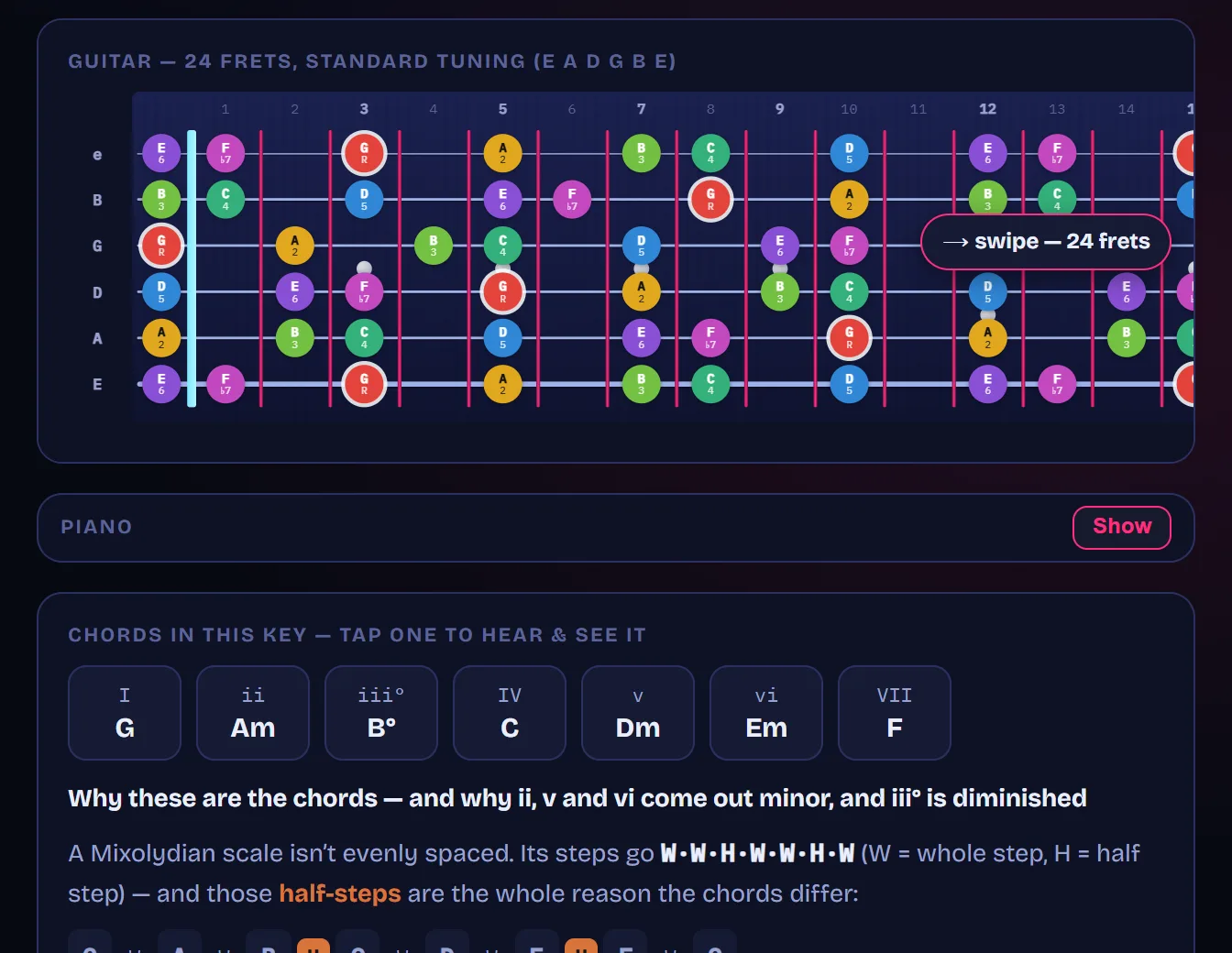
Every root and every scale is in there, along with the chords each key builds. The full tool adds the rest: other tunings and instruments, the circle of fifths and the practice drills. Pair this with scales and the pentatonic scale to see how they all connect.
Reading only gets you so far — open the interactive fretboard and watch these ideas light up on guitar and piano.
Enter the toolFrequently asked
What are guitar modes, simply?
A mode is the major scale started and centred on a different note. Play a C major scale but treat D as home and you get D Dorian; treat G as home and you get G Mixolydian. Same seven notes, different resting point, different mood.
What order are the modes, brightest to darkest?
Lydian (brightest), Ionian (major), Mixolydian, Dorian, Aeolian (natural minor), Phrygian, Locrian (darkest). Each one lowers one note relative to the last.
When would I use Dorian or Mixolydian?
Mixolydian (major with a flat 7th) is the sound of blues, rock and jam bands over dominant chords. Dorian (minor with a bright 6th) is the cool, funky minor used in funk, jazz and modal rock.
Why do modes confuse everyone?
Because they're usually explained in words. They click instantly when you can see the notes on the neck and hear the mood change — which is what the interactive tool is for.