Chords in Any Key
Every key hands you the same seven chords, in the same pattern — learn that pattern once and you can play, transpose and write in all twelve. Pick a key below, hear its chords, then read why they are what they are.
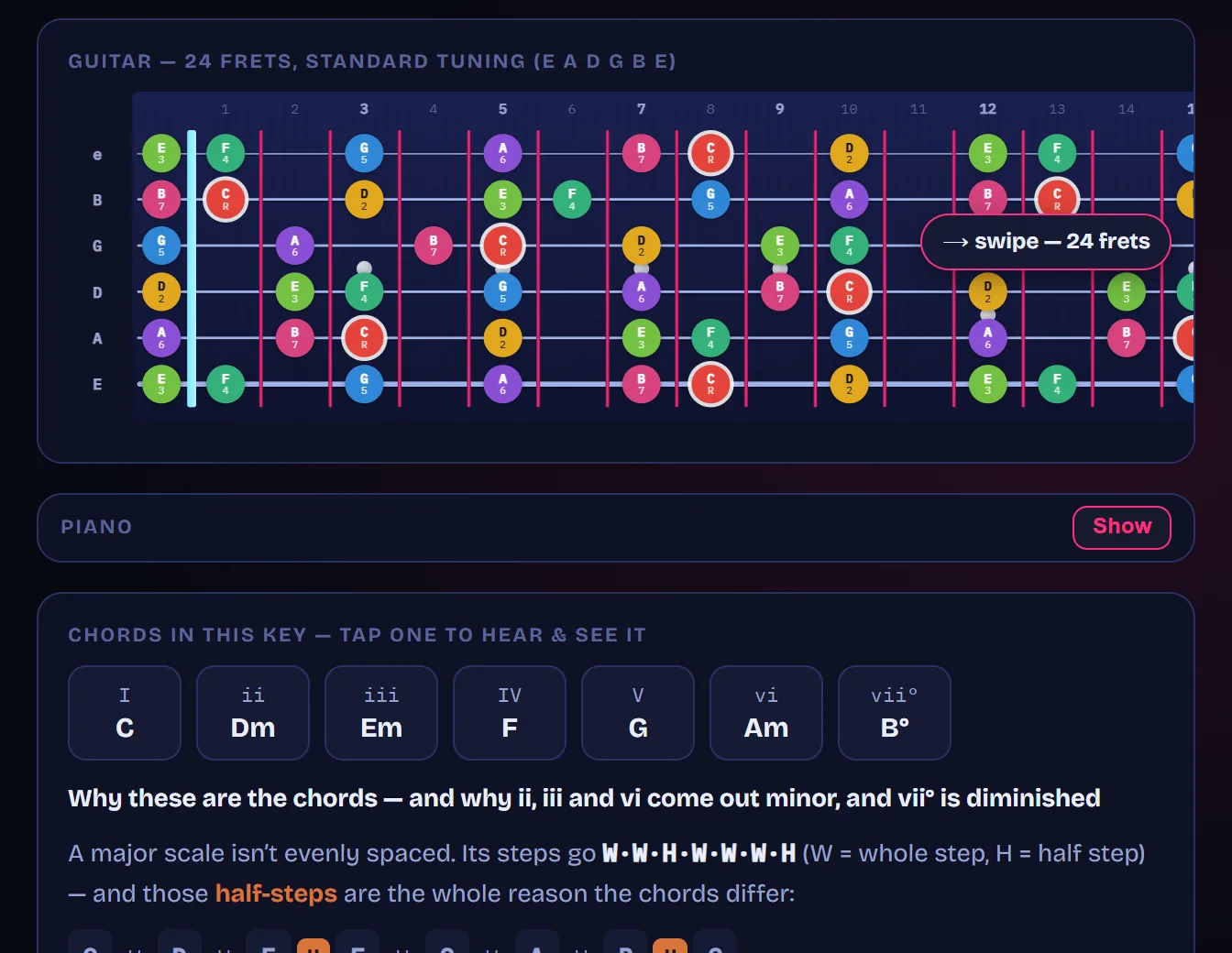
Why the 'chords in a key' is the useful thing to know
A key is a small family of chords that belong together — seven of them, built from one scale, that sound coherent in any combination. Knowing them is the difference between guessing and knowing what will fit. It buys you four superpowers:
- Instant transposing. Write a progression as numbers (I–V–vi–IV) and it works in every key — just re-map the numbers to that key's chords. One idea, twelve keys.
- A palette that fits the key. All seven belong together, so you can jam or write from them and stay coherent — though some (like the restless vii°) are tenser than others.
- Finding a song's key. Match the chords you hear to the key that contains all of them.
- One shared language. "It's a I–IV–V in A" tells a whole band the plan without naming a single chord.
Where the seven chords come from
Here's the part almost nobody explains. A major scale isn't evenly spaced — its steps go whole, whole, half, whole, whole, whole, half (a half-step is one fret; a whole step is two), so its two half-steps always land in the same two places (in C major, between E–F and B–C). You build each chord by stacking thirds: take a scale note, skip one, take the next, skip one, take the next — root, 3rd, 5th, all drawn from the scale.
Because of exactly where those half-steps fall, each chord's two stacked thirds come out either wide (a major 3rd, 4 frets) or narrow (a minor 3rd, 3 frets), and their order decides the quality: wide-then-narrow = major, narrow-then-wide = minor, and narrow-then-narrow = diminished (its outer notes form a tritone — the most dissonant interval there is, which is why it sounds restless). Run that down C major and you always get the same fixed pattern:
I maj ii min iii min IV maj V maj vi min vii° dim
Watch it on the D of C major: D up to F is 3 frets (narrow), F up to A is 4 (wide) — narrow then wide, so Dm is minor. Now the F: F up to A is 4 (wide), A up to C is 3 (narrow) — wide then narrow, so F is major. Nobody chose any of it; only the half-steps moved.
In C that's C · Dm · Em · F · G · Am · B°. Every major key gives the identical pattern— that's the whole reason numbers are more useful than letters. Change the key in the Key row above and watch the chords re-spell while the numeral pattern stays put.
Reading the numbers (and what each chord's job is)
The Roman numerals just name each chord by its step in the scale, and the case tells you the quality: UPPERCASE = major (I, IV, V), lowercase = minor (ii, iii, vi), and ° = diminished (vii°). The numeral is the chord's job, independent of key — V is G in C, D in G, but always "the V". Those jobs group into three families:
- Home (tonic): I, and its softer relatives vi and iii — rest and arrival (iii is the most ambiguous of the three, leaning toward tension about as often as home).
- Away (subdominant): IV and ii — motion away from home that sets up the tension.
- Tension (dominant): V and vii° — they hold the leading tone a half-step under the tonic and pull hard back to I. V→I is the strongest resolution in music.
Nearly every progression is some trip around home → away → tension → home. The full number system goes deeper, and the circle of fifths shows why neighbouring keys share so many chords.
Turn them into songs
Because the pattern is fixed, a handful of number-recipes power a staggering share of music — and they play in any key. The tool has them loaded. Make the board above interactive, then move down inside it with the slider on its right edge — the thin vertical bar with a dot on it, which scrolls the tool without scrolling this page — past the Chords section. They are under Common progressions:
- I–V–vi–IV — the modern pop progression.
- I–vi–IV–V — the 50s / doo-wop loop.
- ii–V–I — the strongest way home; the backbone of jazz.
- I–IV–V — the three major chords, behind whole genres of blues, folk and country.
Tap ▶ on any of them, then change the key above to hear the same progression move through every key while its numbers stay the same. When one grabs you, take it into the jam tool (backing tracks, on Pro) and solo over it with a full band.
Minor keys — one thing to remember
A minor key is built the same way but from the natural-minor scale, giving i · ii° · III · iv · v · VI · VII (in A minor: Am · B° · C · Dm · Em · F · G). Those are the same seven qualities as the relative major, just started in a different place — which is why C major and A minor share all their chords.
The one catch worth memorising: natural minor's v is minor and pulls home weakly, so players very often raise the scale's 7th — that is the harmonic minor scale — to make the V major (or V7)— that borrowed leading tone gives a strong resolution to i. If you ever wonder "why is there a major chord that isn't in my minor scale?", that's almost always it. Push that idea further with secondary dominants. (The rarer melodic-minor chords are an advanced footnote — the major V is the high-value takeaway.)
Reading only gets you so far — open the interactive fretboard and watch these ideas light up on guitar and piano.
Enter the toolFrequently asked
How many chords are in a key?
Seven — one built on each note of the scale. In practice beginners lean on four of them (I, IV, V and vi in a major key), but all seven belong to the key and sound coherent together.
Why is the 2 chord (ii) minor?
It isn't a choice — it falls out of the scale. Stacking thirds on the 2nd degree lands a minor third on the bottom and a major third on top (m3 + M3), which is exactly what makes a chord minor. The pattern of major/minor/diminished across a key is fixed by where the scale's two half-steps sit.
What is the diminished chord (vii°) and why is it rare?
It's built from two stacked minor thirds, which puts a tritone (the most dissonant, restless gap between two notes) between its outer notes. Because it's so unstable it's used far less than the six other triads, usually as a passing chord with dominant function that pushes toward the tonic.
Can I use chords that aren't in the key?
Absolutely. The seven diatonic chords — the ones that belong to the key — are your safe, always-fits palette, not a fence. Borrowed chords — most commonly a major V in a minor key, or a ♭VII in rock — are everywhere and add colour. Learn the key's chords first, then step outside on purpose.
How do I find a song's key from its chords?
List the chords and find the one key whose seven diatonic chords contain all of them; the chord that feels like 'home' (where the song rests) is usually the I. A lone major V in an otherwise-minor set is a giveaway that the song is in a minor key using a raised leading tone.
What's the difference between a key and a scale?
A scale is just the ordered set of notes. A key is the whole system those notes build: a home note (the tonic), the seven chords made from the scale, and the sense of tension and resolution around that home. Scale = raw material; key = the music built from it.
Why does I–IV–V work in every genre?
I, IV and V are the three major chords of a major key, and between them they contain all seven notes of the scale and cover all three jobs — home (I), away (IV) and tension (V). It's a complete, easy-on-the-ear home→away→tension→home cycle, which is why it powers blues, folk, country and pop alike.