Chord Progressions
Most songs you love ride on a short loop of three or four chords. Here are the big ones — played on a real guitar, transposable to any key, with what makes each one tick. Start with the trick that unlocks pop:
One set of chords, four different songs
The Rotate the loop buttons above hide the single most useful thing to understand about pop harmony: C, G, Am and F — just four chords — become four different-feeling progressions depending only on where you start the loop. Bright and anthemic (I–V–vi–IV), or wistful and emotional (vi–IV–I–V): identical chords, opposite moods.
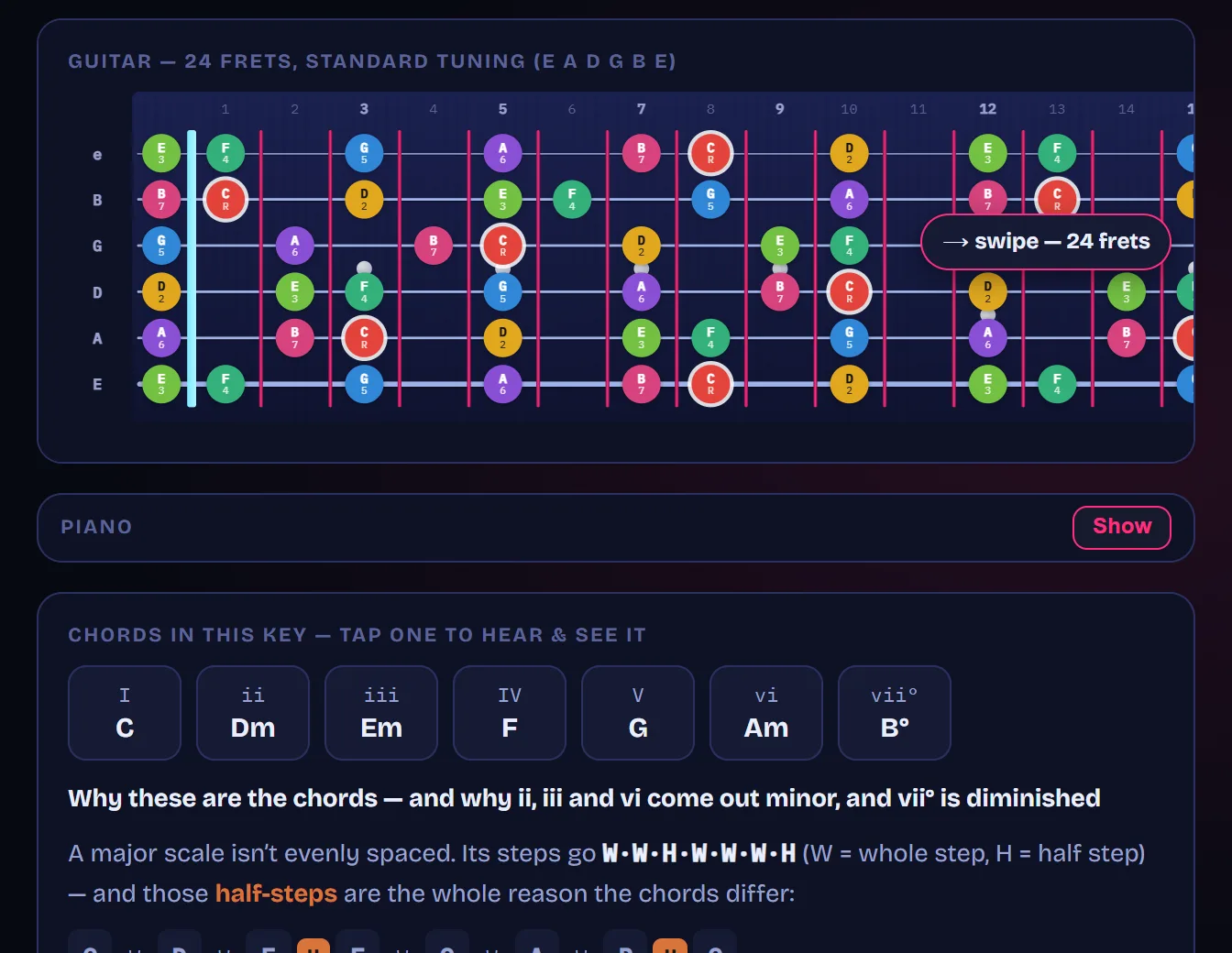
Try it: press a rotation, then the ▶ on its row. Switch rotation and press ▶ again — the mood changes completely. Now drag the bar on the right-hand edge upwards (the line under the frame tells you where you are: Controls, Neck, Chords, Progressions) as far as Neck: it is the same pattern of lit notes whichever rotation you picked. All four use the same seven notes; only the order changes. That one insight explains why so many songs sound both familiar and distinct at once.
Four rotations, four characters:
- I–V–vi–IV — the pop loop. Bright and anthemic with a bittersweet edge; the most common four-chord loop there is.
- V–vi–IV–I — the delayed drop. The same chords, but it finally lands on home at the end.
- vi–IV–I–V — the wistful one. Starts on the minor chord. Heard as a minor key it is i–VI–III–VII.
- IV–I–V–vi — the lift. Opens on the subdominant for a suspended, rising, "here-it-comes" feel.
The other progressions worth knowing
Beyond the four-chord family, a handful of patterns turn up everywhere. They are all in the same panel, Common progressions: the Other big ones and In a minor key buttons jump straight to each, and the ▶ on its row plays it on a real guitar. Drag the bar up to Controls, change the Root, then drag back down to Progressions: every row has re-spelled itself into that key. They're written below in C major (and A minor), but the Roman numerals mean the same thing everywhere. (New to them? Capital = major, lowercase = minor, ° = diminished — the number system has the full story.)
- I–IV–V — the three-chord backbone. Blues, folk, country and rock live here. The three major chords of the key contain all seven of its notes, and the V pulls hard back home to I.
- I–vi–IV–V — the 50s / doo-wop changes. Nostalgic and sweet. Same four triads as the pop loop but re-ordered so it ends on the V — every cycle is an authentic-cadence setup pulling home.
- ii–V–I — the jazz cadence. The smoothest way home in music. The roots fall by fifths (D→G→C) while a guide tone holds and the other resolves down a half-step — pure pre-dominant → dominant → tonic. Jazz nearly always plays it with sevenths (Dm7–G7–Cmaj7), which is where that voice-leading is actually audible; the tool plays it as plain triads, so to hear it go to seventh chords.
- i–VI–III–VII — the epic minor loop. The modern minor-key anthem. Every chord but the tonic is major, so it glows even while it broods — and with no leading tone it loops forever without needing to resolve.
- i–VII–VI–V — the Andalusian (flamenco) line. That dramatic Spanish sound. Its heart is the descending bass A–G–F–E (La–Sol–Fa–Mi), and the final V is major — the one chord in the row that steps outside A minor. That E major brings in a G♯: a leading tone pulling up to A, and that note is the whole bite. And it is not an ending: after the E the row starts over on Am, and it can spin like that all night. In flamenco the E ends up sounding more like home than the Am does — which is why it is also called a Phrygian cadence, after the mode that starts on that note.
The 12-bar blues is the other must-know — a fixed 12-bar map of I, IV and V. Hear and drill it in the 12-Bar Blues Lab: go to the tool's Songs mode and open the "12-Bar Blues" song.
Why the chords sound right together
It isn't luck. Chords from the same key are neighbours on the circle of fifths, and each has a job — a function:
- Home (tonic): I (and its stand-ins vi, iii) — rest and arrival.
- Away (pre-dominant): IV and ii — the departure that sets up the tension.
- Tension (dominant): V — it holds the leading tone a half-step under home and pulls hard back to I.
Nearly every progression is a trip around home → away → tension → home. V→I is the strongest move of all — the leading tone strains upward, the 7th of a V7 slides down, and the root drops a fifth — which is why it feels so final. See exactly which chords belong to a key on the chords-in-a-key page.
How progressions end: cadences
The last chords give a progression its punctuation:
- Authentic (V–I) — the full stop; the strongest, most final ending.
- Plagal (IV–I) — the softer "Amen" ending.
- Half (ends on V) — a comma; it leaves you hanging, wanting more.
- Deceptive (V–vi) — the surprise; V sets up home, then swerves to the minor vi. It's the exact move that keeps the pop loop spinning.
Each one is worth hearing next to another — the cadences page lets you A/B any two in any key, and explains why V–I lands and IV–I only half-lands.
Making them your own
Once a progression feels natural, colour it. Swap a chord for one that shares its job (ii for IV, vi for I). Add a secondary dominant to spotlight the next chord (a D7 leaning into G). Borrow a chord from the parallel key — a minor iv is the classic tear-jerker. And the other way round, in a minor key: raising the v chord's third by a half-step to turn it into a major V — the E in the Andalusian above — is the same move in the opposite direction. Or just change the rhythm and use slash chords to walk the bass. Small changes to a familiar loop are how songwriters keep it fresh.
Hear all of it in the Jam tool, which plays any progression with a full band and lights the notes to solo with — or the Harmony walkthrough, which colours every chord by its job (that last one is a Pro feature).
Reading only gets you so far — open the interactive fretboard and watch these ideas light up on guitar and piano.
Enter the toolFrequently asked
What is a chord progression?
A sequence of chords played in order — the harmonic backbone that gives a song its feel. Most songs are built from a short loop of three or four chords that repeats throughout.
What is the most common chord progression?
I–V–vi–IV (in C: C–G–Am–F). It powers a huge share of pop hits. I–IV–V, I–vi–IV–V (the 50s changes) and ii–V–I are the other everyday staples.
Why do the same four chords work in so many songs?
Because they all belong to one key, so they share notes and move smoothly, staying inside the key; the order creates a self-contained loop of tension and release. And rotating where you START in that loop gives completely different moods from identical chords — which is why one four-chord set underlies so much music.
What makes a progression sound sad or happy?
The biggest lever is the chord quality — a major tonic (starting on I) tends to sound bright, a minor one (starting on vi or i) tends to sound wistful. Slow tempo, a descending bass line, and borrowing a minor chord all push it sadder. (It's a strong tendency in Western music, not a universal law.)
What do the Roman numerals mean?
They number the chords of a key: uppercase = major (I, IV, V), lowercase = minor (ii, iii, vi), ° = diminished. Because they're relative to the key, I–V–vi–IV describes the same progression in every key — you just move the shapes. In the tool above, drag the bar up to Controls, change the Root menu, then drag back down to Progressions: every row has re-spelled itself with that key's chords, while the numerals stay put.
How do I write my own?
Pick a key and use its diatonic chords. Start on I (home), add motion with IV or ii, raise the tension with V (or V7), and resolve back to I. A simple I–IV–V is a complete song engine; then colour it with substitutions and secondary dominants.
Do progressions have to resolve?
No. Classical music uses cadences to close firmly, but a pop loop like I–V–vi–IV avoids a strong V–I on purpose — its V slips to vi instead — so the four chords can cycle forever. Whether to resolve or keep spinning is a stylistic choice.