Secondary Dominants
The single most useful piece of 'grown-up' harmony — one rule builds all of them, they're easy on guitar, and they're the reason a plain progression suddenly sounds like a record. Hear it first, then keep reading.
Every one is a dominant 7th a fifth above its target. Hear the target on its own, then hear its dominant pull into it.
A plain I–vi–IV–V loop. Flip a switch to slip each chord's secondary dominant in just before it — stack all three and you've built a chain of dominants.
The idea: borrow a 'V' for a chord that isn't home
Every major key has one chord that pulls hardest back to the tonic: the V (in C major, that's G or G7 pulling to C). A secondary dominant takes that same pulling power and aims it at a different chord in the key. Instead of "the five of the key", you build the five of another chord— the V of V, the V of vi, and so on. It's written V/V or V/vi and read "five of five", "five of six". (Theory books also call it an applied dominant — same thing.)
New to the Roman numerals? They just number the seven chords of a key — capital for major (I, IV, V), lowercase for minor (ii, iii, vi), counting up the scale. The number system walks through it if you want the full picture; here you only need that each numeral names a chord in the key.
For one moment, that target chord gets treated like a temporary tonic — a trick called tonicization— so it arrives feeling earned and spotlit. Then the home key snaps straight back. That flicker of "are we changing key?" that resolves instantly is the whole emotional payoff.
One rule builds every single one
To turn any chord into a target and build its secondary dominant:
- Find the chord you want to spotlight (say G, the V of C major).
- Go up a perfect 5th from its root (G → D).
- Build a dominant 7th there: D7 (D–F♯–A–C).
- That's V/V. It resolves down a fifth into G exactly like a real V resolves to I.
The magic note is that chord's 3rd — here F♯. It isn't in C major, and it sits a half-step below G: a brand-new, temporary leading tone that yanks upward into the target's root. That single borrowed note is the sound of the device. Because it's generated by a rule, it works in every key — change the key selector in the lab above and the maths re-spells itself correctly.
The five you'll actually use (in a major key)
A major key gives you exactly five, one for each major or minor chord in it. In C major:
- V/ii = A7 → Dm — borrows C♯, the leading tone of D.
- V/iii = B7 → Em — borrows D♯ (and F♯); the spiciest of the five.
- V/IV = C7 → F — the tonic itself turned into a 7th (more on this below).
- V/V = D7 → G — the everyday workhorse that brightens a cadence.
- V/vi = E7 → Am — swings the music toward the relative minor.
There's no V/vii°. The vii° chord is diminished, and you can't tonicize a diminished chord — there's no stable "diminished key" for it to be the home of. So the set really is just these five. Tap "with its V" in the lab to hear each one pull home; the borrowed leading tone lights up as it resolves.
The V/IV trap — why it has to be a 7th
A perfect 5th above F (the IV) lands back on C — the tonic. So the triad of V/IV is just a C major chord, indistinguishable from I. The only thing that reveals it as an applied dominant is the added ♭7 (B♭), turning it into C7. That B♭ is the odd one out among the five: it's a lowered note, not a raised leading tone. The takeaway is a rule you can trust forever: always write V/IV as a seventh chord— a "I7" that leans into IV. It's the classic gospel and blues move of a tonic chord growing a ♭7 and sliding up to the four.
On guitar: the two-fret shortcut
You don't need to do 5th-arithmetic on the fly. To find the secondary dominant of any chord, take its root, move one string up and two frets up, and make a 7th chord there (nudge one extra fret when you cross onto the B string). That's the root of its dominant. And the payoff shapes are ones you already know — E7, A7, D7, C7, B7 are all everyday open or barre grips, often easier to grab than the diatonic chord they're decorating. Here they are on the neck:
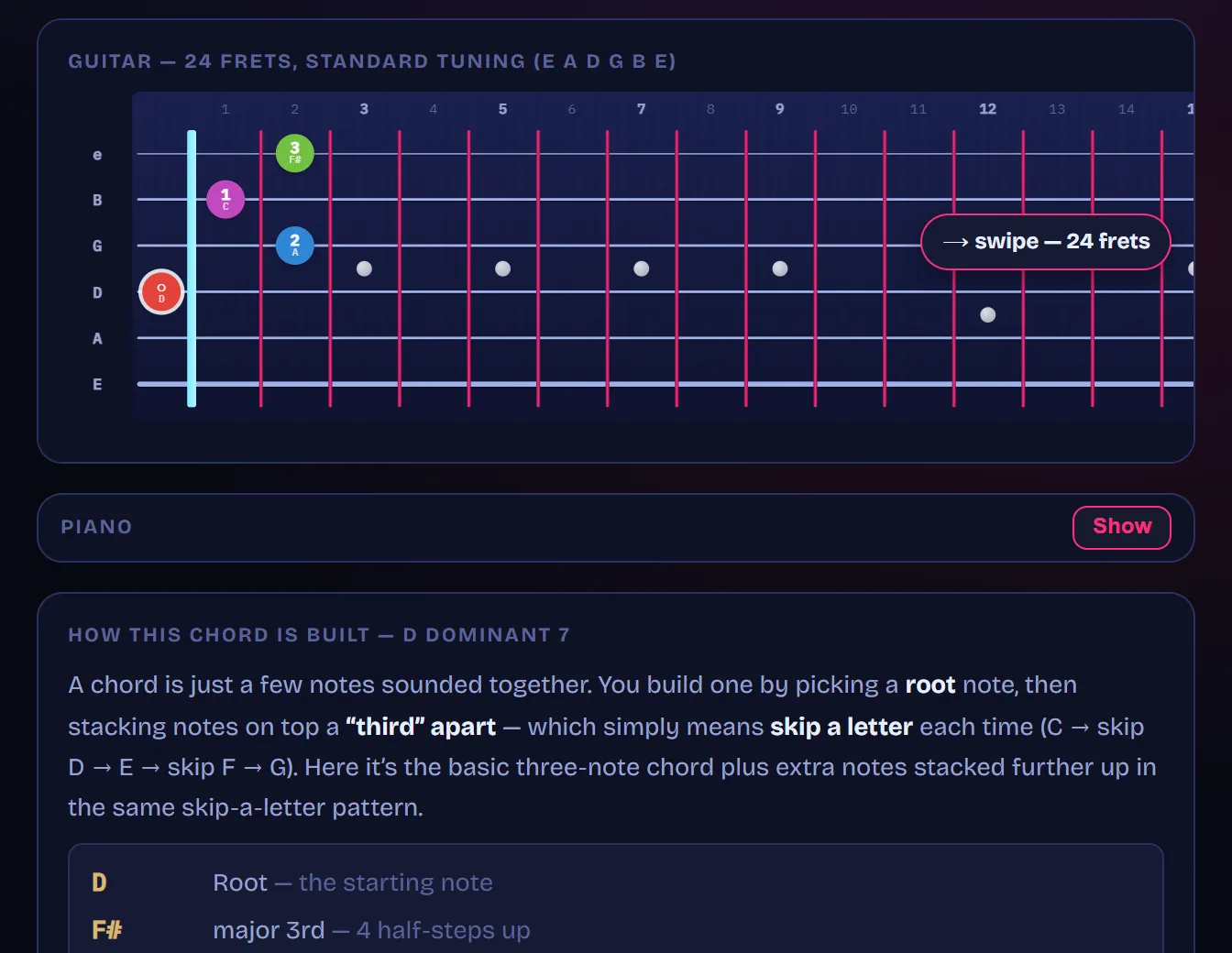
Press the five Secondary dominants in C major buttons. Each one sounds the chord — just the dominant, without its target; the resolution is what the lab at the top of the page is for — and redraws the neck.
Now the rule that works in any key: C major has no sharps and no flats, so any note you see on the neck with a ♯ or a ♭ is the borrowed one. To read it: on each dot, the big number is the finger; the note name sits underneath in small type. Hunt it down in each chord — V/ii (A7) brings in a C♯; V/iii (B7), two at once, D♯ and F♯; V/V (D7), an F♯; and V/vi (E7), a G♯.
V/IV (C7) is the exception: its borrowed note is a B♭, a lowered note rather than a raised leading tone — so it pulls down, to the A of F major, instead of pushing up. That is what the V/IV trap above is about.
One thing that trips people up: all five are the same dominant 7th chord. They look different on the neck only because each one uses different open strings; barred, it is a single movable shape — the one from the two-fret shortcut above. And if you drag the bar on the right-hand edge, the tool lists every note of the chord with its job, just below the board.
Stack them: chains of dominants
Because each dominant 7th wants to fall a fifth, you can line several up so each one resolves into the next — a chain of dominants. The famous one is the ragtime turnaround: E7 – A7 – D7 – G7 – C, which is V/vi – V/ii – V/V – V – I functionally: five dominant chords tumbling around the circle of fifths until they finally land home. In the lab above, switch on all three toggles at once and you've built exactly this kind of cascade. Jazz players go further, tucking a little ii chord in front of each dominant (Am7–D7, Dm7–G7…) so the whole passage becomes a run of overlapping ii–V cells.
In a minor key
The same rule applies, you just tonicize different chords. In a minor key the most idiomatic is V/iv (in C minor, C7 → Fm), plus V/V, V/VI and V/III. One neat quirk: because a natural-minor key already contains a major chord on its ♭7, the dominant of the relative major can be fully diatonic — the same chord reads as either the subtonic VII7 or as V/III, and only where it resolves decides which. Songwriters reach for these a little less in minor than in major, but V/iv and V/V are well worth stealing.
One step further: secondary leading-tone chords
There's a close cousin. Instead of building a dominant a fifth above the target, you can build a diminished chord on the note a half-step below it — a secondary leading-tone chord like vii°7/V— and let it resolve up into the target. It's essentially a secondary dominant with its root left off, so it does the same job with an even smoother, more chromatic bass. Worth knowing exists; the five dominants above are what you'll use ninety percent of the time.
Tonicization vs. modulation, in one line
People tangle these two, but the difference is just how long it lasts. A secondary dominant is a tonicization: a fleeting nod to another chord, no cadence, and you're still in the home key. A modulation commits — it cadences in the new key and stays a while. If the music returns home right after, it was a secondary dominant. If it settles in, you've changed key. Want to see which key a passage really lives in? The key finder and the harmony walkthrough in the tool (a Pro feature) both make the pull audible.
Reading only gets you so far — open the interactive fretboard and watch these ideas light up on guitar and piano.
Enter the toolFrequently asked
What is a secondary dominant in simple terms?
It's a dominant 7th chord borrowed to point at a chord other than the tonic. A normal V pulls to I; a secondary dominant is the 'V of' some other chord in the key — written V/V, V/vi, V/ii and read 'five of five', 'five of six'. It briefly makes that target chord feel like a temporary home, then the song snaps back.
How is a secondary dominant different from a borrowed chord?
A secondary dominant has a job: its raised note is a temporary leading tone that pulls UP a half-step into its target, so it demands to resolve. A borrowed (modal-interchange) chord is about colour, usually brings LOWERED notes (♭3, ♭6, ♭7) from the parallel key, and has no obligation to resolve anywhere.
Why is it a dominant 7th and not just a major chord?
It can be a plain major triad, but the added ♭7 supplies a tritone with the 3rd — the same tension engine that gives a real V7 its pull. The one case where the 7th is mandatory is V/IV: its triad is identical to the tonic (in C, C major = I), so only the added ♭7 (making C7) reveals it as an applied dominant.
How is it different from changing key (modulation)?
Same mechanism, different scale. A secondary dominant is a momentary tonicization — a chord or two, no cadence, still analysed in the home key. A modulation establishes and confirms the new key (usually with a cadence) and stays there. The test: look at what follows. Back to the home key = secondary dominant; stay put = modulation.
How do I find a secondary dominant on guitar?
Take the chord you want to spotlight, find its root, then move one string up and two frets up — that's the root of its dominant. Make that a 7th chord. Most land on easy open or barre shapes: E7→Am, A7→Dm, D7→G, C7→F. They're often easier than the diatonic chord they decorate.
Can every chord have a secondary dominant?
Every major or minor chord in the key can — in a major key that's ii, iii, IV, V and vi. You cannot tonicize a diminished chord (there is no 'diminished key' for it to be the tonic of), so vii° gets none. That's why the usable major-key set is exactly five.
How do I hear a secondary dominant?
Listen for a sudden brightness and a chromatic note that isn't in the key, followed by a strong V7-style resolution that lands hard on a diatonic chord. V/V and V/vi are the two you'll meet most often in real songs.