Seventh chords
Every seventh chord is a triad you already know with one more third stacked on top. Which third you stack decides whether the chord floats, aches or pulls you home — and you can hear the difference in about ten seconds.
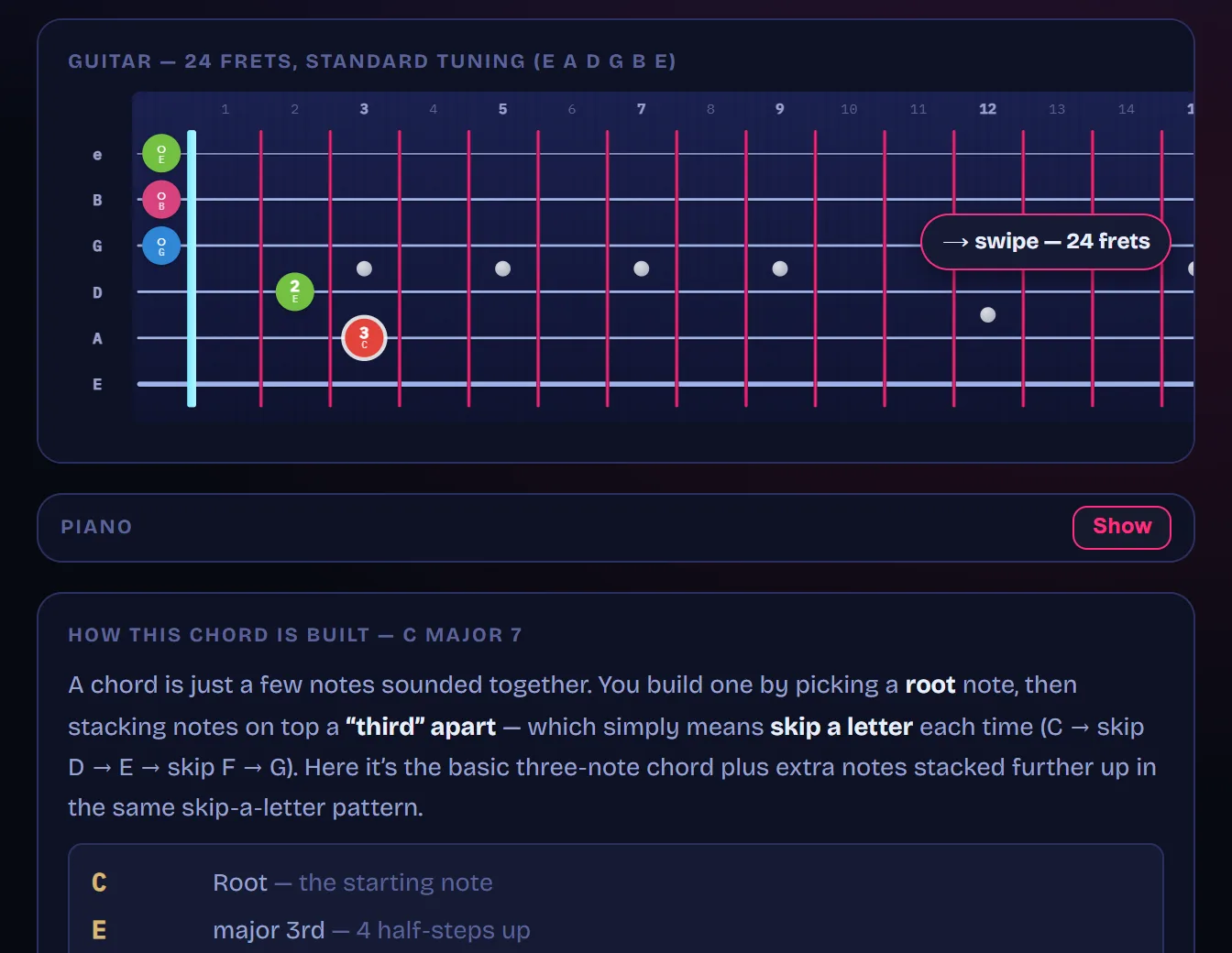
The board starts on Cmaj7, with its button already lit. Press the other four in the Seventh type row: each one sounds the chord and redraws the neck. The fingering rebuilds completely every time — an open shape here, a barre there — so don’t go looking for a dot that slides. What changed is in the note list of the How this chord is built panel, below the board: C–E–G–B becomes C–E–G–B♭. One note moves, down a fret.
But not always the same note. B→B♭ turns Cmaj7 into C7; then the third drops (E→E♭) for Cm7; then the fifth (G→G♭) for Cm7♭5; then the seventh again (B♭→B♭♭) for C°7.
On another root? Drag the bar on the right-hand edge up to Controls and change Root. The five buttons keep working — they only set the seventh type — so from then on they play all five on the note you picked.
One more third. That’s the whole idea
A triad is built by skipping notes: take the scale, start on a note, skip one, take the next, skip one, take the next. C major gives you C–E–G. A seventh chord is what happens when you refuse to stop — skip one more, take one more, and now you have four notes.
The reason this matters is that the note you land on is not always the same distance away. Keep stacking inside C major and the fourth note is B, a semitone below the octave. Do the same thing starting on G and the fourth note is F — a whole tone below the octave. Same procedure, different result, and that difference is the entire subject.
The five you will actually meet
Guitarists run into five, and they are easiest to hold in your head as a ladder where each rung lowers one note by one fret:
- maj7 — major triad, major 7th on top. C–E–G–B. No tritone anywhere in it, which is exactly why it can hang in the air without resolving.
- 7 (dominant) — major triad, minor 7th. C–E–G–B♭. Drop that one note a fret and the 3rd and the 7th become a tritone apart. That gap is the sound of the blues and of the V–I ending.
- m7 — minor triad, minor 7th. C–E♭–G–B♭. Soft and loopable; no tritone, so it never demands to go anywhere.
- m7♭5 (half-diminished) — diminished triad, minor 7th (the 5th drops a fret). C–E♭–G♭–B♭. Unsettled, but the ♭7 on top keeps it from sounding melodramatic.
- dim7, written °7 — diminished triad, diminished 7th (the 7th drops again). C–E♭–G♭–B♭♭ (yes, a double flat: it sounds like A, but it is spelled as a B because the top note has to be a seventh counted up the letter names, C→D→E→F→G→A→B). Each note a minor third above the one below, two tritones inside it, and no fixed home. The most useful unstable chord there is.
There is a sixth, m(maj7) — a minor triad with a major seventh. It is rare, deliberately uncomfortable, and it is the backbone of the spy-film sound — the James Bond theme’s signature chord is a minor-major. It is not in the Seventh type row above because it turns up as a passing sound far more often than as a chord you go looking for — though if you want to see it, the board has it: drag up to Controls and pick Minor–major 7 from the Chord menu.
Before moving on, hear it. There is a lab below, and it is not the board from the top of the page doing the same job again: the board shows you the shape, the lab makes you hear the new note arrive — it plays the bare triad first, then the whole seventh chord. Its closing table, the sevenths a key contains, is exactly what the next section explains.
Dreamy and settled. The major 7th sits one fret below the root and rubs against it gently — which is why it sounds lush rather than tense.
Stack a seventh on every degree of the scale and see what you get. Nothing here is chosen — each chord is built by stacking scale notes, and the quality is whatever comes out.
Imaj7 Cmaj7 | iim7 Dm7 | iiim7 Em7 | IVmaj7 Fmaj7 | V7 G7 tritone | vim7 Am7 | viim7♭5 Bm7♭5 tritone |
Exactly one plain dominant 7 in the whole key — on V7. Nothing else in the key sounds like it, which is why hearing one tells your ear where home is.
Notice what is missing: the diminished 7th comes out of neither natural scale. It needs a raised 7th degree — the leading tone — which is why it is born in the harmonic minor. It is not a minor-key exclusive, though: major borrows it constantly, as a chromatic passing chord and as the leading-tone chord of some other degree.
Roman numerals name each chord's job in the key: capital = major, lowercase = minor, and lowercase with a ° or a ♭5 means diminished.
Why the dominant seventh is the special one
Build a seventh chord on every degree of a major scale and something striking falls out: only one of the seven is a plain dominant seventh. In C major it is G7, and there is no other chord in the key with that sound. Change to another major key and it moves with you, but there is still exactly one. Minor keys are a different story — see below.
That is what makes it function as a signpost. A minor seventh could be chord ii, iii or vi — hearing one tells you very little. A dominant seventh has only one diatonic address, so hearing one is a strong hint about the key and about what comes next. A hint, not a law: blues puts a dominant seventh on I and IV as well, and borrowing the sound on purpose is exactly what secondary dominants do. This is the mechanism underneath cadences and the reason secondary dominants work at all: borrow that sound and you can point at almost any chord in the key.
The engine is the tritone between the 3rd and the ♭7. In G7 that is B and F — three whole tones apart, the most unstable interval in the system. B wants to rise a semitone to C; F wants to fall a semitone to E. Both of those are notes of the C chord, so the resolution is not a convention, it is two lines each moving one fret to the nearest comfortable place. It is the most restless interval in tonal music, and that restlessness is the whole engine.
Where each one lives in a key
In a major key the pattern never changes, whatever the key: Imaj7, iim7, iiim7, IVmaj7, V7, vim7, viim7♭5. Learn it once and it transfers everywhere, which is the same trick the Nashville number system is built on.
Natural minor gives a different set — im7, iim7♭5, IIImaj7, ivm7, vm7, VImaj7, VII7 — and notice the dominant seventh has moved off V, onto VII (many books write it ♭VII — same chord). That chord does not pull home, though — it points at III, the relative major, because that is whose V7 it actually is. Natural minor has no dominant of its own: its seventh degree is a subtonic, a whole tone below the tonic, rather than a leading tone a semitone below. Raise it by hand and two things happen at once — chord V becomes a real dominant seventh that does lead home, and the diminished seventh chord appears, which is in neither natural scale.
If you want to see the triad version of the same map first, the chords in a key page covers it, and triads covers what you are stacking on.
Playing them without growing a sixth finger
Seventh chords are frequently easier than the triads they come from. Cmaj7 is a C with a finger lifted, E7 is an E with a finger lifted, and an open Em7 is down to a single finger — though C7 goes the other way and wants one more than C. The jazz shell voicings go further and simply drop notes: with a bass player in the room the root is redundant, and the 5th of a dominant seventh contributes almost nothing, so a huge amount of comping is just the 3rd and the 7th plus whatever colour you fancy.
That pair is worth isolating — they are called the guide tones — because for maj7, 7 and m7 those two notes are the chord. Keep the root and drop the 3rd and you cannot tell major from minor; keep the 3rd and the 7th and drop everything else and the chord is still completely recognisable. The two diminished ones are the exception: in m7♭5 and °7 the ♭5 is not decoration, it is what makes them those chords, so it stays. On adjacent strings the guide tones sit a fret or two apart — one fret for a dominant seventh’s tritone, two for maj7 and m7 — and barely move between chords, which is what makes inversions and voice leading feel effortless once you switch to four-note chords.
Try it with your hands
Play these four in a row and move nothing but one finger, on the B string:
- Dm — xx0231
- Dm(maj7) — xx0221
- Dm7 — xx0211
- Dm6 — xx0201
The voice that moves is D–C♯–C–B, one fret at a time. It is not the highest note in the chord — the F on the top string stays put — so listen inward for it. In four chords you have played a triad, an m(maj7), an m7 and an m6, and you have played the descending line that sits under a great many ballads and most of the spy-film music ever written. That second chord, the m(maj7), is the sound of the intrigue.
Major works the same way — C, Cmaj7, C7, C6, with the voice falling C–B–B♭–A. Note the fourth chord: it is C6, not Cm7. Going to Cm7 would leave the seventh where it is and lower the third instead, so the line stops. That is worth knowing precisely because the ladder of the five chords above and the descending line are two different things that look alike.
The tool at the top of this page does not stop at these five — drag the bar on its right-hand edge up to Controls and you can build any of them on any Root, in any tuning. To drill telling them apart by ear, go to the ear trainer.
Reading only gets you so far — open the interactive fretboard and watch these ideas light up on guitar and piano.
Enter the toolFrequently asked
What is a seventh chord?
A triad with one more third stacked on top, giving it four notes instead of three. A C major triad is C–E–G; keep stacking thirds in the same pattern and you add a B or a B♭, which makes Cmaj7 or C7. The name 'seventh' comes from that top note being the seventh note of the scale, counting the root as one.
What is the difference between Cmaj7 and C7?
One fret. Cmaj7 is C–E–G–B; C7 is C–E–G–B♭. That single semitone changes everything: in C7 the E and the B♭ are a tritone apart, and a tritone is unstable, so the chord leans somewhere. In Cmaj7 there is no tritone at all, so it can sit still. That is why maj7 sounds dreamy and 7 sounds like it is about to go somewhere.
Why is the dominant seventh called 'dominant'?
Because in a major key it only occurs on the fifth degree — the dominant. Stack sevenths on all seven degrees of C major and you get Cmaj7, Dm7, Em7, Fmaj7, G7, Am7 and Bm7♭5: exactly one plain seventh chord, on G. Since no other chord in the key sounds like that, hearing a dominant seventh is a strong signpost for both the key and the chord that follows.
What is a half-diminished chord?
A diminished triad with a minor seventh on top — written m7♭5 or ø7. It is 'half' diminished because only the triad underneath is diminished — the seventh on top is a plain minor seventh. Lower that top note one more fret and the seventh is diminished too, which is the fully diminished chord. In a minor key, m7♭5 is the chord on the second degree, the normal setup before the dominant.
Are seventh chords harder to play than triads?
Often the opposite on guitar. Several seventh shapes need fewer fingers than the triad they come from — Cmaj7 is C minus a finger, E7 is E minus a finger, Em7 is an open Em down to one finger — and the jazz shell voicings drop the notes you do not need. Some go the other way: C7 wants one more finger than C. What is actually harder is knowing when to use them, which is what the sound of each one tells you.
Which seventh chord goes with which scale degree?
In a major key: Imaj7, iim7, iiim7, IVmaj7, V7, vim7, viim7♭5. In natural minor: im7, iim7♭5, IIImaj7, ivm7, vm7, VImaj7, VII7. Note that the fully diminished seventh appears in neither — it needs a raised seventh degree, so it comes from harmonic minor. Major keys use it constantly anyway, as a chromatic chord that slides between two chords of the key.