The Circle of Fifths
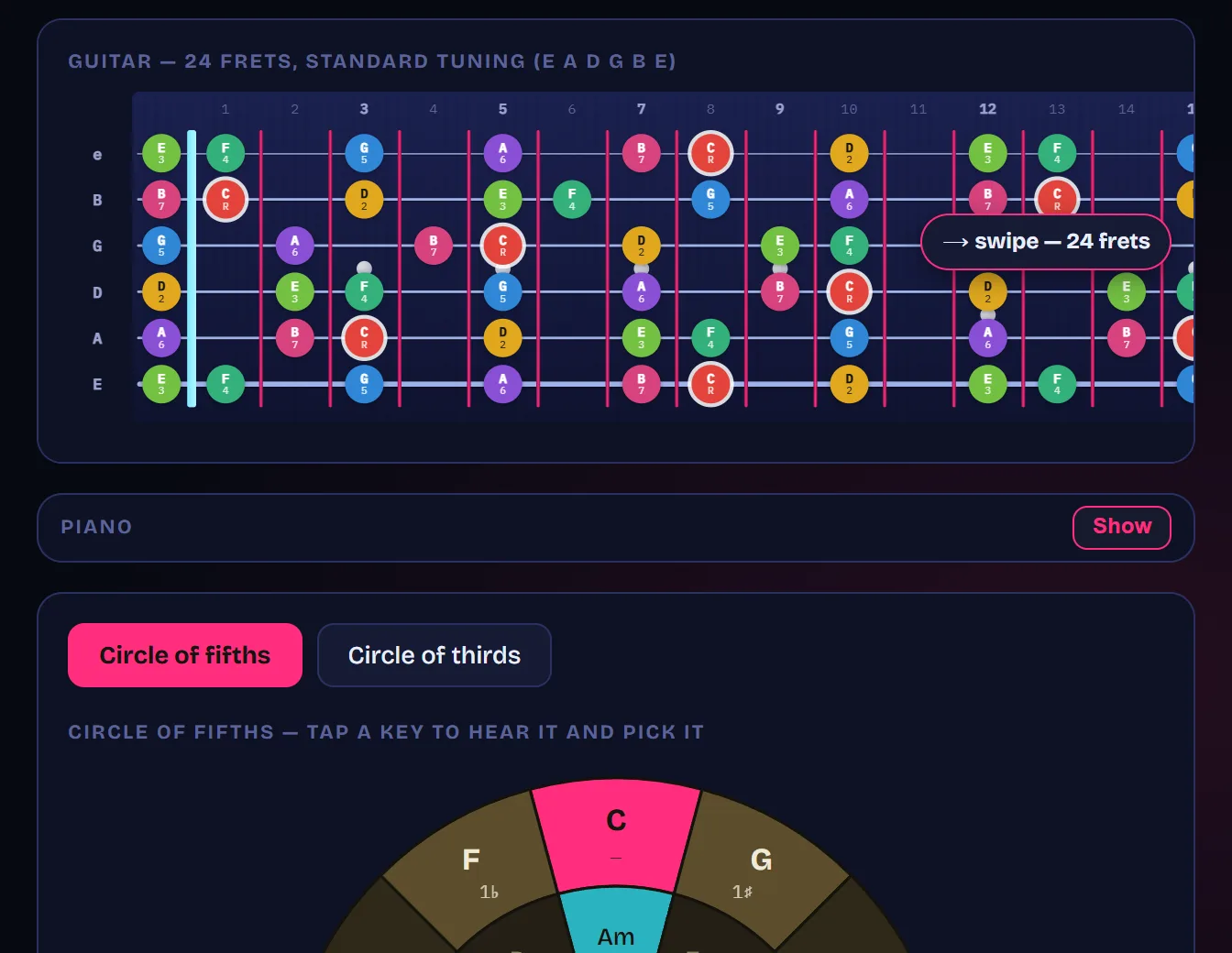
If you learn one diagram in music, make it this one — it ties together every key, its signature, its relative minor and its chords. Make the tool below interactive and pick a key — on the wheel, or in the Key row underneath it: you'll hear it on a real guitar and watch its chords light up.
What it is, and why fifths
The circle of fifths arranges all twelve keys in a ring so each step clockwise is a perfect fifth up:
C → G → D → A → E → B → F♯ → D♭ → A♭ → E♭ → B♭ → F → back to C
Keep stacking fifths and you pass through every note exactly once before you land home. The reason that's so useful: going up a fifth changes a major scale by exactly one note. C major → G major keeps six of seven notes; only F becomes F♯.
So neighbours on the wheel share almost all their notes — and therefore almost all their chords. Distance around the circle is how far apart two keys sound.
But why is the fifth the interval everything is built from? Physics, not convention: two strings a fifth apart vibrate in a 3:2 ratio — the higher one completes three vibrations in the time the lower completes two, so their motion lines up again on a regular beat.
You can watch it happen. Make the tool above interactive, then move down inside it with the slider on its right edge — the thin vertical bar with a dot on it, which scrolls the tool without scrolling this page — until you are past the Chords section. The two vibrating strings sit there, and you can switch between the octave, the fifth, the fourth and the tritone to see which line up again and which never do.
The inner ring: relative minors
Every major key has a relative minor that shares its exact key signature and sits a minor third below(the 6th degree): C major / A minor, G major / E minor, and so on all the way round. That's the inner ring of the wheel. Because they share every note, a major key and its relative minor share every chord too — which is why you can slip between happy and sad without changing a single grip. The whole inner ring is itself a circle of fifths of the minor keys, so the two rings turn together.
The wheel literally shows a key's chords
This is the part that makes it a guitarist's best friend. (New to the Roman numerals? They just number a key's chords — capital = major, lowercase = minor, ° = diminished; the number system has the full story.) For any major key, its three main chords are itself plus its two immediate neighbours: one step counter-clockwise is the IV, one step clockwise is the V. So C's three main chords, read left to right on the wheel, are F (IV) · C (I) · G (V) — three adjacent slices. Drop into the inner ring and the relative minors directly beneath those three give you the rest: Am (vi), Dm (ii), Em (iii). That little cluster is six of the key's seven chords— the only straggler, vii°, sits directly across the circle from the IV. Select a key on the wheel above and watch the whole neighbourhood light up. A key isn't a list to memorise; it's a place.
Reading key signatures off the wheel
Because each clockwise step adds one sharp and each counter-clockwise step adds one flat, a key's position tells you its key signature — how many sharps or flats it has — at a glance; the hub in the middle of the wheel spells it out. The sharps always arrive in the same order — F C G D A E B("Father Charles Goes Down And Ends Battle") — and the flats in the exact reverse, B E A D G C F. (At the very bottom of the wheel the two sides meet: F♯ major and G♭ major are the same six-accidental key spelled two ways.)
Two tricks let you name any key from its signature without counting round the wheel:
- Sharp keys — the last sharp is the leading tone (the note a half-step below the key that pulls up to it). So go up a half-step from the final sharp to find the key: three sharps end on G♯ → the key is A.
- Flat keys — the second-to-last flat names the key. Four flats (B♭ E♭ A♭ D♭) → the second-to-last is A♭ → the key is A♭. (This needs at least two flats, so F, with its single B♭, is just remembered.)
Progressions are just paths around the circle
Chord roots love to fall by a fifth — that's a counter-clockwise step — and that single move is the engine of tonal music:
- V → I (the strongest resolution): standing on the V, one step counter-clockwise takes you home — G to C. (Same step as before, seen from the other end: if C is home, G is its right-hand neighbour.)
- ii – V – I, the backbone of jazz, is two steps landing on the tonic (Dm → G → C).
- vi – ii – V – I is a four-chord counter-clockwise slide — the classic "circle progression".
- The ragtime dominant chain (E7–A7–D7–G7–C) keeps falling by fifths all the way home.
See these as chord progressions and they're abstract rules; see them on the wheel and they're short walks you can trace with a finger.
Changing key, made visual
The circle also maps the smoothest key changes. Move to an adjacent key (one step right, to the V, for a bright lift; one step left, to the IV; or hop to the relative minor, which shares all seven) and it feels seamless. Jump to the opposite side of the wheel and you share the fewest notes — dramatic, jarring, the sound of a bold modulation. Songwriters lean on this constantly to lift a final chorus. Take any key from the wheel into the full tool to explore its chords and scale on the neck.
Reading only gets you so far — open the interactive fretboard and watch these ideas light up on guitar and piano.
Enter the toolFrequently asked
What is the circle of fifths for?
It's a single map of all twelve keys. In one diagram it gives you every key's signature (how many sharps or flats), shows which keys are closely related, pairs each major key with its relative minor, and even predicts which chord progressions will sound strong. It's a lookup table and a songwriting compass in one.
How do I read it?
Start at the top: C, with no sharps or flats. Each step clockwise adds one sharp; each step counter-clockwise adds one flat. The outer ring is the major keys, the inner ring their relative minors. A key's two neighbours are its IV (to the left) and its V (to the right).
How do I find a key's chords with the wheel?
Take your key plus its two neighbours — that's IV, I and V, the three major chords. Then the three relative minors sitting directly inside them give you ii, iii and vi. That cluster is six of the key's seven chords; the leftover diminished vii° sits directly across from the IV.
Why do the sharps and flats add up as you go around?
Because moving up a fifth changes a major scale by exactly one note — it raises what becomes the new key's leading tone, adding one sharp. So each clockwise step adds a sharp and each counter-clockwise step adds a flat. A key's position on the wheel literally is its accidental count.
What's the difference between the circle of fifths and the circle of fourths?
They're the same wheel read in opposite directions. Clockwise, each step is a fifth up (the sharp side); counter-clockwise, each step is a fourth up, which is a fifth down (the flat side). Most chord progressions actually move the 'fourths' way — counter-clockwise — because roots love to fall by a fifth.
Do I need to memorize it?
No — that's the point of having the diagram. Understand the pattern (fifths around, one accidental per step, relative minor tucked inside) and you can rebuild it any time. The interactive wheel above does the lookup for you.